Touch does not disqualify nonspeakers' communication
What if I told you that scientific research shows human touch can help people regulate, learn motor skills, and even improve aspects of written communication — not just nonspeaking autistic people, but neurotypical adults writing essays, children learning motor skills, and students forming memories?
Human beings, across development, rely on touch far more than this debate usually admits. And the people shouting loudest about the dangers of touch in assisted communication have apparently never read much of the research.
On May 1, the New York Times published a guest essay by Amy S.F. Lutz, a historian of medicine at the University of Pennsylvania, titled "Profound Autism Is Difficult Enough Without This Debunked Method." In it, she argued that motor-based communication methods like Spelling to Communicate are not only unproven but actively harmful — and that the physical presence of a communication partner holding a letterboard is evidence enough to dismiss the communication as inauthentic.
Lutz is a historian of medicine, not a communication researcher, not a neuroscientist, not a speech-language pathologist. The studies she relies on to declare motor-based communication debunked are dated, and the primary instrument she treats as a gold standard — the message-passing test — has itself never been independently validated.
As I have written previously, the message-passing test does not appear in the Mental Measurements Yearbook, the standard reference for validated assessment tools. There is no technical manual. No published reliability or validity metrics. No norming sample. No psychometric body has sanctioned it as a standardized measure. And yet it is used to deny nonspeaking people access to communication, education, and legal standing.
"The message-passing test is not a validated instrument," said Barry Prizant, Ph.D., CCC-SLP, who has practiced for more than 50 years. "It has none of the basic fingerprints of a validated assessment."
The New York Times published none of this context. It published Lutz's opinion as if the science were settled. It is not.
- Why Message Passing Is Invalid — The Test Used to Deny Communication
David Kaufer on Substack: a detailed look at why the message-passing test lacks the basic fingerprints of a validated instrument, and what that means for how its results have been used in policy and media.
Touch is how humans learn everything
When a parent holds a toddler's hands above their head to help them take their first steps, nobody argues the child is not really walking. When a swimming instructor places a hand under a child's stomach in the water, nobody suggests the child is not really swimming. When a physical therapist guides a stroke patient's arm through a repeated movement to rebuild a damaged motor pathway, nobody claims the patient is not doing the work.
Touch is how motor skills are learned. It is how the body receives the scaffold it needs while a new neural pathway is being established. The support is not the performance. The support makes the performance possible.
Stephen Hawking communicated through a computer system that tracked his cheek muscle movements, interpreted them through software, and produced synthesized speech. The technology was the medium. Nobody ever suggested his published physics belonged to Intel. The accommodation was not the communication. He was.
The skeptics' logic, applied consistently, would require them to make that argument about Hawking. They never do. Which tells you something important about whose communication they are actually questioning.
What the research actually says
In 2023, researcher Giulia Pavon completed a PhD thesis at Nottingham Trent University titled Probing Facilitated Communication Beyond the State of the Art. Unlike most research in this space, Pavon actually tested what touch does to communication in neurotypical people with no disabilities at all.
The results were striking. When ordinary adults wrote essays with a hand resting on their shoulder, their analytical thinking scores were significantly higher than when they wrote without any touch. Comparison words increased. Quantifiers increased. The writing became more organized, more precise, more complex. Touch did not corrupt the writing. It improved it.
A 2023 peer-reviewed paper in Frontiers in Integrative Neuroscience proposed a neurophysiological pathway by which touch could lower the cognitive and sensorimotor load of seated typing for people with developmental disabilities, freeing up mental resources for the actual communication. The paper concluded that the process is best understood as a collaborative effort rather than a binary question of who is authoring the message.
A 2026 review article from UC Berkeley researchers Ozge Ugurlu and Dacher Keltner, published in Frontiers in Psychology, synthesized evidence that interpersonal touch supports emotional well-being, communicates emotional states, and facilitates emotion regulation through neurophysiological responses.
And the developmental literature is unambiguous. Touch is the earliest sensory modality to develop in humans. Research across human and animal models shows it activates oxytocin, dopamine, and endogenous opioid systems that are fundamental to social learning, attachment, and cognitive development.
Touch is not a contaminant introduced into communication by motor-based methods. It is the original scaffold of all human learning and development.
Stone and the letterboard
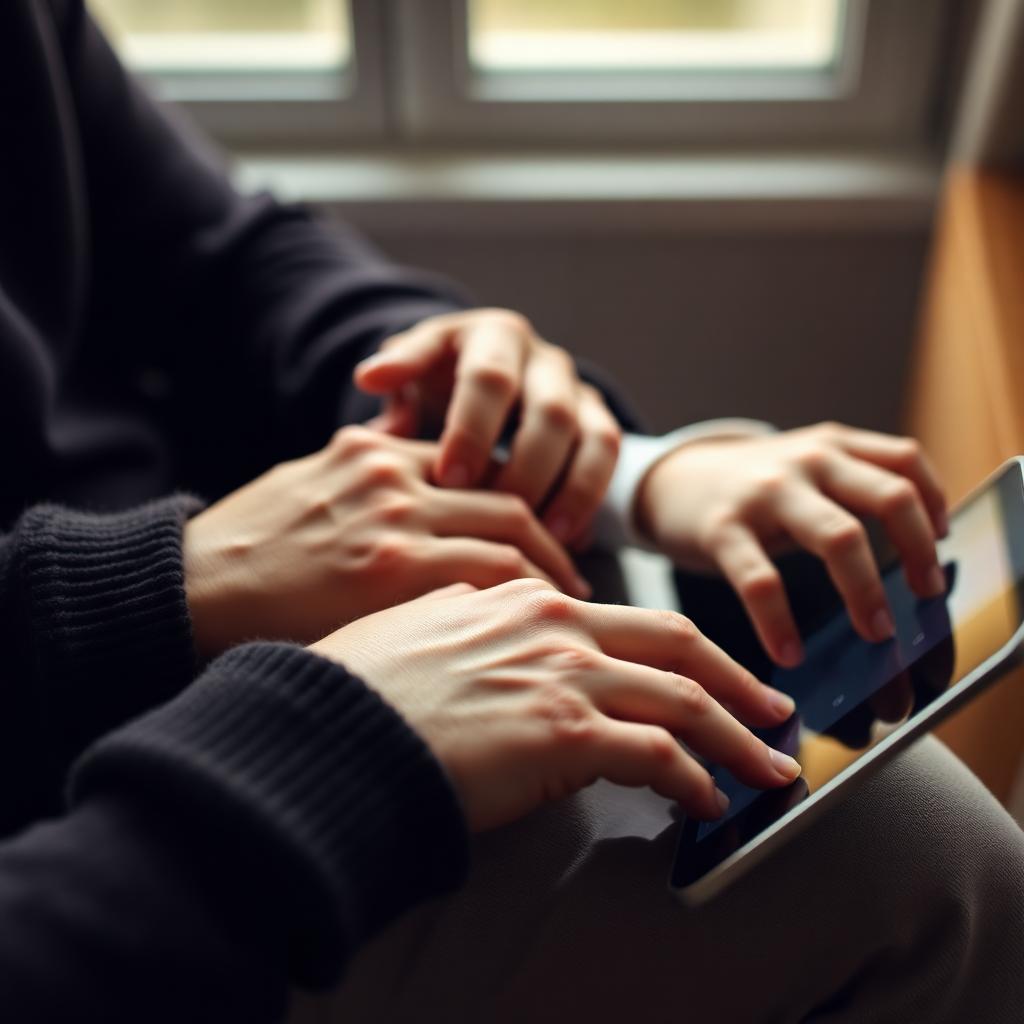
My son Stone is twenty years old. He communicates by typing, letter by letter, on a keyboard or iPad. When we sit down to work together, he often reaches over with his non-typing hand and holds mine. We sit like that, his free hand in mine resting beneath the keyboard while his other hand does the work of spelling out his thoughts.
There is something about that physical connection that grounds him. It regulates him. It settles the motor and sensory noise enough for the pathway to open. My hand is not directing his finger. My hand is simply there. And its being there lowers the threshold for his own motor system to do what it already knows how to do.
Every parent who has held a child's bicycle seat while they found their balance understands this without needing a research paper to explain it. The contact is not the riding. The contact is what makes the riding possible.
Why it matters
The message-passing test removes the stabilizing presence of a trusted communication partner, introduces novelty and stress, places the nonspeaking person under scrutiny, and then demands flawless motor performance under those destabilizing conditions. Unsurprisingly, people with motor planning challenges often struggle. The test then calls that failure proof of fraud. That is not a controlled experiment. That is a setup.
Stone's words did not make it into the New York Times. Neither did Hari Srinivasan's, the Phi Beta Kappa UC Berkeley graduate and National Science Foundation fellow at Vanderbilt. Neither did Elizabeth Bonker's, the valedictorian of Rollins College. Neither did the words of thousands of nonspeaking individuals who have used motor-based communication to tell the world, for the first time, what they already knew.
They always had something to say. The research says touch may simply help them say it easier — as it does for nearly all humans.
Cited sources
- Pavon, G. (2023). Probing Facilitated Communication Beyond the State of the Art (PhD thesis, Nottingham Trent University).
- Nicoli, G., Pavon, G., Grayson, A., Emerson, A., & Mitra, S. (2023). Touch may reduce cognitive load during assisted typing by individuals with developmental disabilities. Frontiers in Integrative Neuroscience, 17, 1181025.
- Ugurlu, O., & Keltner, D. (2026). Touch as emotion regulation. Frontiers in Psychology, 16, 1418374.
- Van der Weel, F. R., & Van der Meer, A. L. H. (2024). Handwriting but not typewriting leads to widespread brain connectivity. Frontiers in Psychology, 14, 1219945.