Communication support does not replace a voice. It helps that voice be heard.
The Communication Access Project is an independent research translation and communication access platform offering clear, credible, context-rich information about assisted communication for people who cannot rely on spoken language.
We exist because public understanding of assisted communication has too often been shaped by incomplete evidence, outdated assumptions, and collapsed categories. Distinct approaches are frequently treated as if they are all the same, while the experiences of people who rely on communication support are too often left out of the conversation.
This site brings together research, lived experience, clinical insight, safeguards, and rights-based context in one place. We are not here to promote one method, provider, university, nonprofit, or organization. We are here to help families, journalists, clinicians, educators, researchers, advocates, and policymakers understand the communication access landscape with greater clarity, fairness, and care.
Content developed and reviewed with input from people who use assisted communication, families, SLPs, OTs, BCBAs, MSWs, educators, researchers, and advocates
This project is a collaborative effort grounded in research, practice, lived experience, and a shared commitment to meaningful communication access.
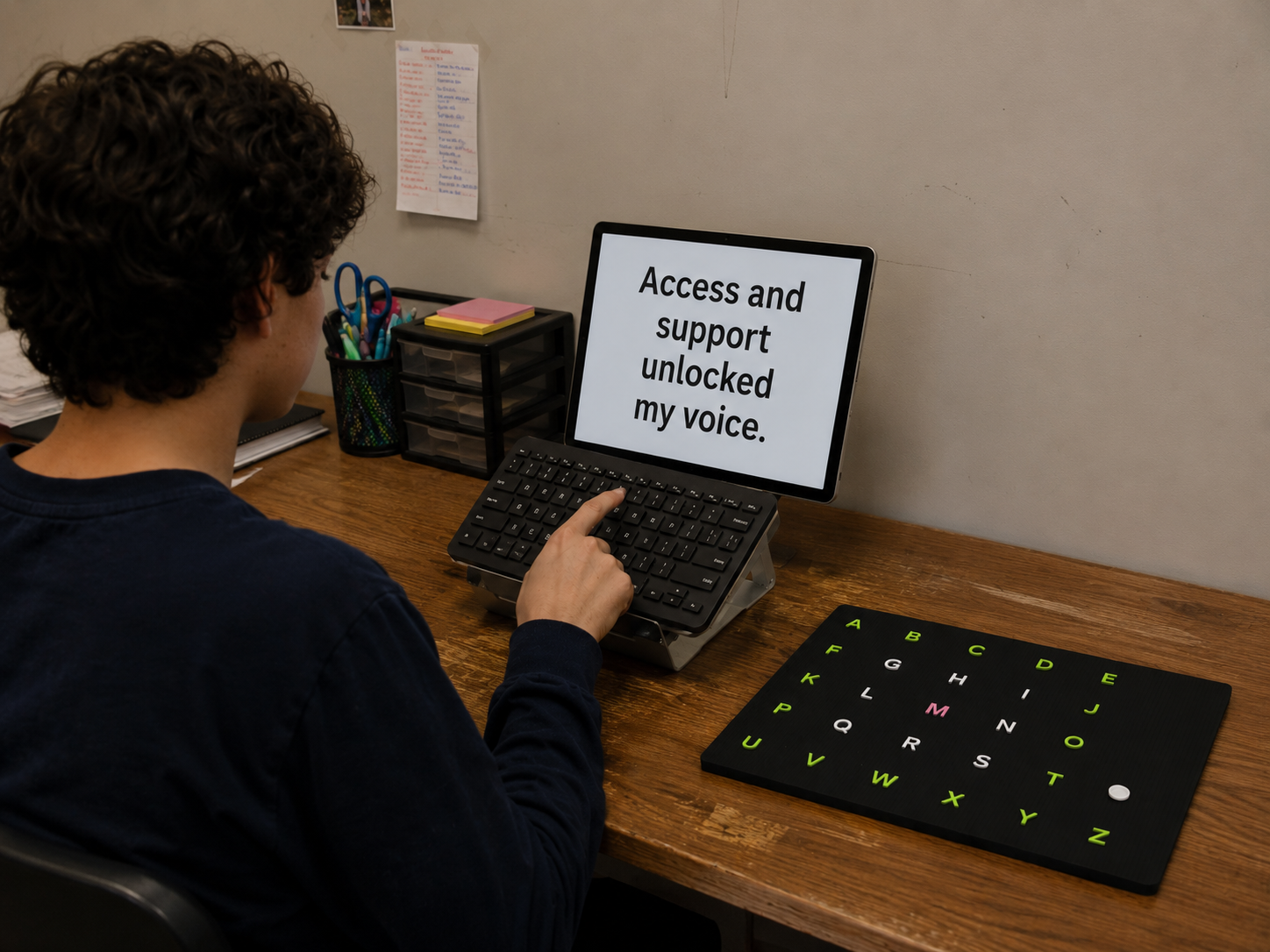
When we use terms like nonspeaking or nonspeaker, we are referring broadly to people whose speech does not provide a reliable, robust, or sufficient means of communication. This may include people with no spoken language, limited spoken language, inconsistent speech, or scripted speech that may not fully reflect their thoughts, intentions, feelings, or knowledge. Our focus is communication access, informed choice, dignity, and the principle that every person deserves a meaningful way to be heard.
Some critics would have you believe that every supported spelling, typing, or otherwise assisted communication approach is simply "Facilitated Communication" by another name. That framing collapses distinct methods, ignores how each approach has evolved, and keeps today's conversations stuck in yesterday's assumptions.
Facilitated Communication is part of this history, and it should be understood with honesty, context, and respect. Controversies arose, lessons were learned, practices changed, and new methods, safeguards, and training models emerged. FC is not something to erase from the story. It helped open a door that many people had been told would never open.
This site exists to separate fact from fiction, share current research, and explore how communication access has evolved. Around the world, tens of thousands of people are living proof that addressing motor challenges can help unlock voices that traditional communication options failed to reach. Today's conversations should be informed by today's evidence, not yesterday's assumptions. Each approach is distinct, and each deserves to be understood on its own terms.
Explore methods →Facilitated means supported.
Human beings learn movement through support all the time. The word "facilitated" only became suspicious in one narrow corner of the conversation.
A parent steadies the saddle until a child finds balance. The support is real, and then it fades.
A physical therapist guides a limb to rebuild neural pathways after injury. No one calls this cheating.
An ASL interpreter bridges thought and shared voice. The message belongs to the signer.
After a stroke, hand-over-hand practice helps a person re-learn movement they once owned.
Nobody questions this kind of help.
Across mobility, rehab, and sport, hands-on support is how humans learn motor skills. The last clip applies the same principle to communication.
A parent steadies the bike.
Hand on the seat, running alongside — until balance becomes their own.
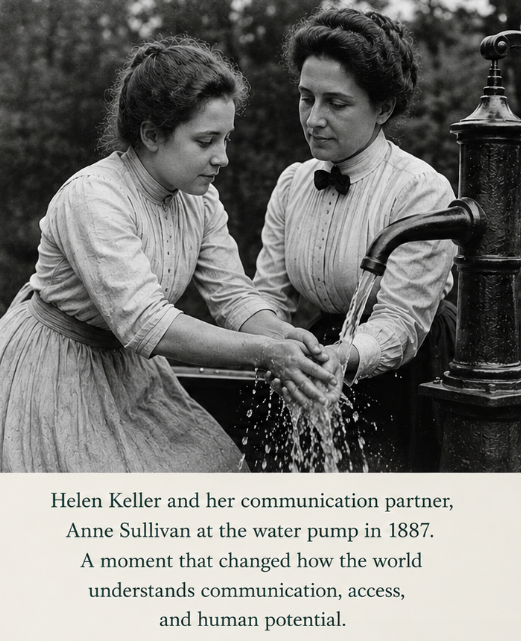
Hand-over-hand is how Helen Keller found language.
At the water pump in 1887, Anne Sullivan spelled W-A-T-E-R into one of Helen's hands while the other felt the water flow. The support was physical. The understanding was Helen's. The world did not call it cheating — it called it a breakthrough.
More than a century later, the principle is the same. Some people need a partner's steady presence to bridge intention and expression. That is not a trick. It is how communication has always begun for those whose bodies need a hand to find the letters.
Podcast with Brooks Hamilton, Helen Keller's great niece →Open letter to UPenn about Amy Lutz →
The science of movement
It is not a cognitive deficit. It is a motor execution challenge.
People with whole-body or global apraxia often need support learning how to get their bodies to execute what their brains already intend. Over time, that support can evolve, fade, and become more automatic — just like any other motor learning process.
Apraxia, not absence
Whole-body apraxia decouples intention from action. A person can know exactly what they mean to do — and still need help getting their body to execute it.
Sensory regulation first
When the nervous system is overwhelmed, deliberate movement gets harder. Support helps regulate so the mind can express itself.
Motor learning, then fading
Like riding a bike or rehabbing after injury, supports evolve and fade as the learner's body builds new pathways toward independence.
The questions people actually search.
Short, evidence-based pages answering the questions the dominant search results get wrong.
Common questions, calmly answered.
The old narrative recycles the same handful of claims. Here is what the evidence — and the people doing this work every day — actually shows.
Pathways into the evidence.
The same research, organized for the audience you belong to.
For Researchers
Open questions, outcome signals worth studying, and the path toward billing codes that match how this work is actually delivered.
Research agenda →For Clinicians
SLPs, OTs, and educators: how motor-based and text-based methods fit alongside AAC, and where the evidence actually sits.
Clinical pathways →For Families
If your child has unreliable speech, you are not alone. Start here for plain-language guidance, what to look for, and what to expect.
Start here →Stay with the work.
One thoughtful email a month. No spam, no fundraising blasts.