Support Is Not Substitution: Nonspeakers Deserve the Same Safeguards, Common Sense, & Communication Rights
There is a strange double standard in the way some people talk about nonspeaking communication. When a toddler is learning to walk and a parent holds their hands, we do not assume the child will never become more independent. When the same support shows up at a letterboard, suddenly it becomes evidence that something suspicious is going on.
When a swimming instructor places a hand under a child's stomach in the pool, we do not say the instructor is swimming. We understand the difference between support and substitution.
But when a nonspeaking person is supported through a trusted communication partner, a letterboard, keyboard, regulation support, or motor coaching, a different standard often appears. Suddenly, support is treated as proof that something suspicious is going on. Touch becomes "contamination." Assistance becomes authorship. The person's words are dismissed before they are even considered. That is not science. That is bias hiding inside a test.
A note about voice and authorship
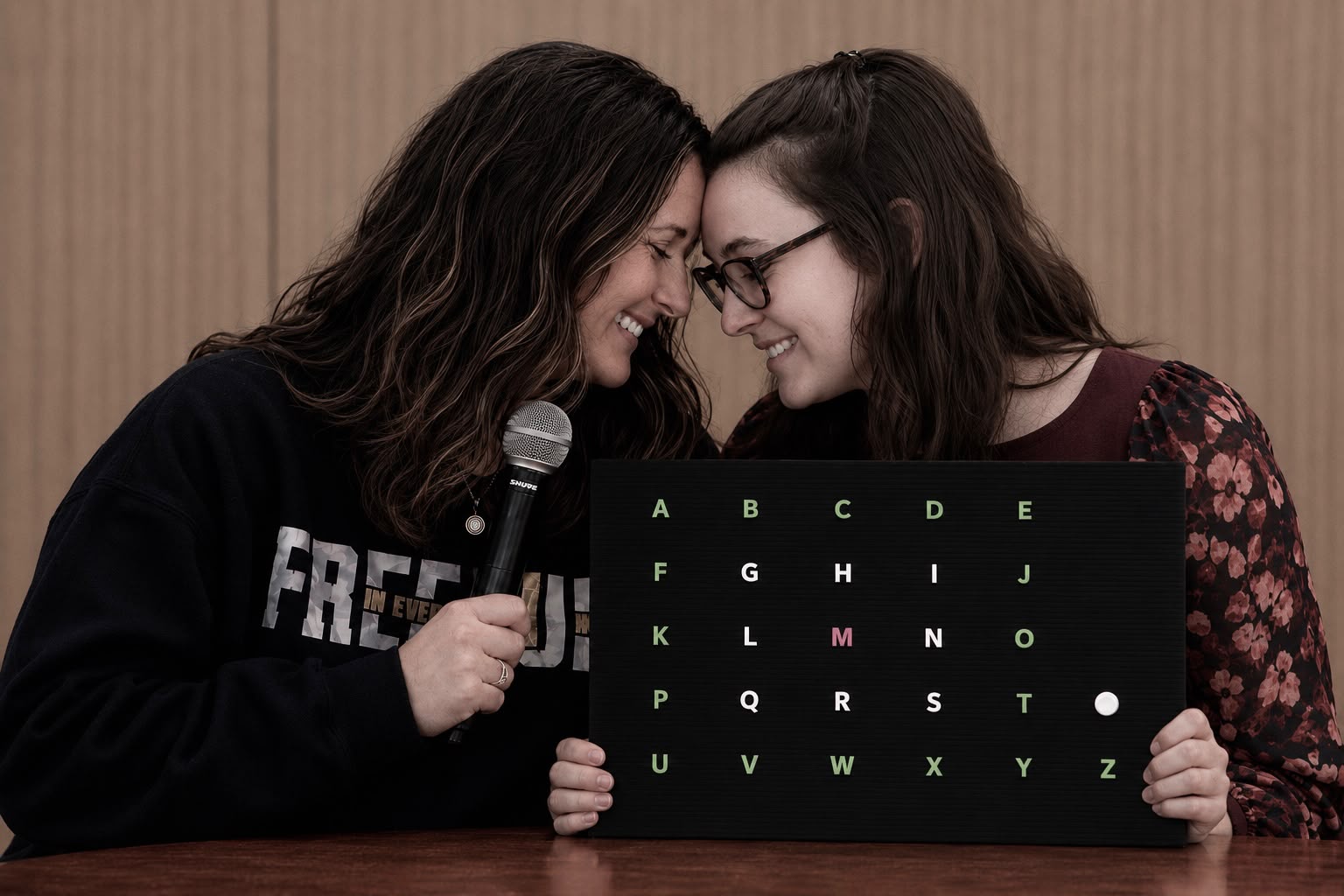
This piece is written by me, Devyn's mother, with Devyn's own words woven throughout. Devyn is 19 years old, nonspeaking, and lives with whole-body apraxia. She communicates using spelling, typing, gestures, body language, facial expression, choices, trusted relationships, and years of being deeply known by the people closest to her.
Devyn's own words appear in quotes throughout. The rest is my reflection as her mother: what I have witnessed, what I have learned from her and dozens of other nonspeakers, and what I believe the world needs to understand about support, communication, motor disability, dignity, and the law.
The "debunked" claim is too simple
The phrase "facilitated communication has been debunked" is repeated so often that many people accept it as settled fact. But as I have read the research, listened to nonspeakers, and reflected on our own experience, I have come to believe the story is far more complicated than that simple phrase allows.
Much of the debate centers on message-passing studies from the 1990s. Those studies raised legitimate concerns about the possibility of influence, and I do not dismiss those concerns. Influence can happen in any communication relationship, and protecting a person's authorship and autonomy matters deeply.
But those studies did not answer every question about every nonspeaking person who uses support. They did not fully explore how apraxia, sensory differences, regulation challenges, motor planning difficulties, trusted relationships, or the stress of being tested under suspicion might affect performance.
Most of us understand that performance can change under pressure. If someone were asked to take a driver's test in a blizzard, we would recognize that the conditions were not neutral. A failed test under those conditions would not tell us what the person understands about driving. It would tell us that the testing environment made an already complex motor task harder to perform.
People who do not speak English fluently may need an interpreter in a hospital, courtroom, or school meeting. We do not assume the interpreter is misrepresenting the person's thoughts. We recognize that support may be necessary for communication to be understood. People who are nonspeaking deserve that same common sense.
The better question is not, "Can this person communicate without any support at all?" It is, "What supports allow this person to communicate effectively, reliably, and as autonomously as possible?"
Touch is part of human learning
In David Kaufer's article "Touch Does Not Disqualify Nonspeakers' Communication," he makes an important point that should be obvious but is often missing from this debate: touch is not an unusual contaminant introduced by motor-based communication methods. Touch is one of the first ways humans learn. It can regulate, stabilize, orient, coordinate, and help the body know where it is in space.
Anyone who has taught a child to ride a bike understands this. At first, you hold the seat and run beside them. Then you let go for a few seconds. Then longer. Some children eventually ride independently. Others continue using training wheels, a tricycle, or an adaptive bike. That does not mean they were never riding. It means their body requires support, and the support should match the person's needs.
The same principle applies to communication. For people who are nonspeaking and type, the barrier is not the absence of thought. It is the body's ability to reliably carry thought into action. A person may know exactly what they want to say and still struggle to initiate, sequence, aim, or complete the motor action required to spell it. The breakdown happens in the body's ability to execute the movement consistently.
When the disability is motor-based, removing support does not reveal some deeper truth about what a person can or cannot do. It simply takes away the tools they need to participate.
What support feels like from the inside
Being Devyn's mom taught me that autonomy is not the same as doing everything without help. When her school district denied her a reasonable accommodation in kindergarten, they argued that the very nature of her disability was a reason to deny her the support she needed. We fought that argument for eight years in federal court and prevailed, helping establish an important precedent: a school cannot use a child's disability as justification for withholding support, and providing accommodations is often the only way to discover what is possible.
Judy Heumann once said, "Independent living is not doing things by yourself. It is being in control of how things are done."
Devyn knows this. She lives it: "I do not have the luxury of pretending help is unnecessary." So instead, she works to preserve autonomous control inside the reality of needing help. Guiding caregivers, making choices, finding workarounds, and fighting for the parts she can do herself are all ways she protects that agency.
Apraxia is cruel that way. A skill that seems solid in one setting can disappear entirely in another. In crowded or unfamiliar places, Devyn often clings to us. As she has put it: "It might look like I am blind, and in that moment, I kind of am." And: "The motor part of my vision freezes. My eyes stop working together." That is not refusal. It is her body losing access to a skill she may have at another moment.
She has also said: "When your body is uncooperative, you can either lie there and do nothing, or you can find trusted partners who are determined to live life with you, not for you." Support is not the same as someone directing her life. Support is often what allows her to participate in her own life.
Touch, trust, and the body
For Devyn, touch has never only meant "help." It means safety. Regulation. Orientation. Motor planning. Connection. Trust. "What I wish people understood," she has said, "is that touch is not always about guidance, but can be about regulation and connection."
My father had Parkinson's, and I supported him too. I would gently put my arm under his elbow and help him get to his destination safely. Devyn typed, "No one said that supporting him meant he wasn't the one walking. We saw the effort it took for every step, just like the effort it takes for me to tap each letter."
When I support Devyn's body near the letterboard, I am not taking over her thoughts any more than I took over my father's movement when I walked beside him. I am helping her body warm up. I am helping her catch her rhythm. She still has to make every choice. She still has to find every letter. But she does it with someone beside her, not hovering over her expecting failure.
When support is allowed everywhere except communication
When Devyn was little, therapists and teachers used touch to help her trace letters, push buttons on a device, zip a coat, and learn new movements. Hand-over-hand support, physical prompting, modeling, co-regulation, and motor coaching were treated as normal parts of disability support — until the task became communication.
Devyn was clear about why the high-tech device in her backpack did not give her the same access as her letterboard: "I have never cared whether or not my expensive communication device was in there because that doesn't help me in the same way. The smooth backlit screen hurts my eyes, I can't feel what to press, it is all flat. It is not as motivating as the iPad, so basically I have hit the same few buttons since I was in preschool. They are my button habits, totally meaningless."
Too often, systems see an inconsistent body and assume the mind is inconsistent too. Panic gets mislabeled as refusal. Dysregulation gets treated as incompetence. The need for support becomes evidence against the person instead of evidence that access is required.
Why message-passing tests can become gatekeeping tools
There may be situations where authorship needs to be evaluated carefully, especially in legal, medical, or safety contexts. But careful evaluation is not the same as hostile testing. A message-passing test that removes trusted supports, introduces unfamiliar people, increases stress, ignores motor planning differences, and then treats dysregulation or motor failure as proof of inauthenticity is not a neutral assessment.
When people who are nonspeaking are placed in these situations, the stakes are impossibly high. They know that if their bodies fail in that moment, people may decide they are incompetent. As Devyn has said: "We sense the magnitude of it all. We know what is at risk."
At program, surrounded by people who knew her, Devyn still could not get her body under control. She tumbled to the floor. "I even threw my letterboard out of disgust. They took that to mean I did not want to spell, or worse, that I could not. My heart sank. In that moment, without a trusted partner, there was no way to set the record straight."
She describes the experience this way: "Once we think about it and want to do it, our bodies have a 90% chance of going haywire."
Imagine asking a person with a mobility disability to prove they can safely cross a room, but first taking away their walker, changing the floor surface, turning off the lights, and surrounding them with strangers. If they fall, would we conclude they cannot walk at all? Or would we conclude the test was designed without regard for their disability?
Influence is real, but influence is not the same as authorship
Critics often argue that because support can influence communication, the communication must not belong to the nonspeaker. That logic collapses under its own weight. Communication is always influenced by context. Students write differently depending on the teacher's prompt. Witnesses answer differently depending on how a lawyer phrases the question. We do not respond to those realities by saying communication is impossible. We create better conditions.
The right question is not, "Was there influence?" It is whether the support was necessary for access, whether it was requested or accepted by the person, whether it was trained and transparent, whether the person's agency was protected, whether there were safeguards against cueing or coercion, and whether the person communicates more effectively with this support than without it.
The ADA does not require unsupported communication
The Americans with Disabilities Act is built around a different principle: equal access. The ADA does not say people with disabilities only have rights when they can perform tasks in the same way, at the same speed, and without support. For people with communication disabilities, the ADA requires effective communication.
The standard is not "prove you can communicate without support." It is not "use only the method we are comfortable with." It is not "pass a test designed around suspicion before we listen to you." The standard is effective communication.
In public settings covered by Title II, including public schools and state and local government programs, the person's requested aid must be given primary consideration. The starting point is the person's actual communication need, not institutional preference, professional bias, or outdated assumptions.
We already understand this in every other disability context
A person who is blind is not told their access to written information is invalid because they used Braille or a screen reader. People who are Deaf are not told their testimony is invalid because an interpreter voiced it. We do not question whether a wheelchair user truly entered a building simply because a ramp made entry possible. A person with limited hand function is not stripped of ownership over their email because they used dictation software.
Yet people who are nonspeaking are often told exactly that: if they need support, their communication is suspect. This is not how disability rights work. Accommodations do not erase the person. They remove barriers between the person and the world.
Support should come with safeguards, not stigma
A serious communication rights framework does not deny risk. It addresses risk responsibly. Communication partners must be trained. Support should be transparent. Motor coaching should be documented and reduced over time when possible. Teams should watch for cueing, coercion, over-prompting, or influence. Authorship should be taken seriously. People who are nonspeaking deserve access to multiple communication tools, including robust AAC.
But none of those safeguards require a blanket ban on touch, motor coaching, or partner support. Banning support represents the least scientific and least lawful response, because it ignores the person's actual disability-related access needs. The better standard is the least intrusive support that allows the person to communicate effectively, with dignity, privacy, and agency.
What Devyn wants people to understand
Devyn wants a voice more than almost anything. She has worked hard to build motor skills in other areas of her life, and she knows that some skills can become more automatic with practice. Communication is no different in principle. But it is harder, higher stakes, and more vulnerable.
"It frustrates me to no end," she has said, "that learning this skill has been so taxing and progress is anything but consistent." Progress is not always linear. When Devyn's body is worked up, when a seizure is brewing, or when people demean her without even knowing, she cannot always pull herself out of the spiral without kindness, reassurance, motor coaching, and touch.
Touch is not only functional. It is human. Just like someone might want their spouse to hug them after a hard day, Devyn craves that connection too. She has shared a grief that cuts deep: "I worry that with my chaotic body, I might never go on a real date, let alone get married."
These are whole people. They want autonomy, relationships, privacy, dignity, and choice over who supports them. They want to be believed enough to be heard and respected enough to be questioned fairly. "In some settings," Devyn has said, "I have zero control over who supports me." That is one of the hardest realities of disability. Support is necessary, but choice over support is not always protected.
The cruelty of "all-motor and no-brain"
One of the most painful patterns I have watched is the way people who are nonspeaking are often funneled into tasks that demand motor compliance while being denied access to communication that would reveal thought, preference, humor, refusal, complexity, and intelligence.
Devyn has named that clearly: "It is disrespectful to put me in situations that are all-motor and no-brain." That sentence should stop people in their tracks. People who are nonspeaking are asked to sweep, sort, wipe tables, stack chairs, tolerate hand-over-hand support, and perform entry-level tasks in front of peers. But when they ask for support to communicate, suddenly the same adults become concerned about independence.
The contradiction is staggering. Hand-over-hand support is routinely accepted for compliance, yet touch for self-expression is often treated with suspicion. Support should not be considered appropriate when the goal is obedience but questionable when the goal is voice. That is not autonomy. That is control.
A different starting point
We need to stop asking, "How do we protect systems from being fooled by nonspeakers?" We need to start asking, "How do we protect people who are nonspeaking from being silenced by systems?" That does not mean believing every message without consideration. It means not using suspicion as the default setting. It means evaluating communication with the same seriousness, nuance, and disability-informed reasoning we would use for anyone else.
Touch does not automatically disqualify communication. Support does not automatically erase independence. A communication partner does not automatically become the author. A letterboard is not a confession of fraud. A body that needs help is not a mind that lacks thought.
If your grandmother needs your arm to safely cross the room, you supported her movement. You did not move for her. The same is true when Devyn holds onto me to spell or to walk — her effort, her intention, her authorship are still there.
The part people do not see
There are moments when Devyn's frustration compounds, but apraxia can steal her right to have an outburst. Devyn has written: "There are moments where my rage builds and I want to scream. But the sad thing is, my apraxia is so intense that no noise might come out at all. Reduced to silent sobs and then I cannot even coordinate the motor movement to wipe away my tears."
That is the reality people miss when they make confident claims from a distance. They may never see the effort, the panic, the humiliation, or the grief of being misunderstood by people who think they are being objective. They may never understand what it costs a person to keep trying after their hardest moment has been used as evidence against them.
But Devyn keeps trying. In her words: "I pray for the ones who cheer me on. They fuel me. And thank God, I have more of them in my life than people who doubt me."
Support is not substitution. Access is not cheating. The right to communicate should not depend on whether your body can do it alone.