Five Things Everyone Should Understand About ASHA
Across the United States, schools and state agencies — including developmental disability systems such as OPWDD — often behave as if the American Speech-Language-Hearing Association (ASHA) were a public regulator. When families request motor-based spelled communication, they are told, "We cannot. ASHA does not support that." Evaluators cite ASHA position statements as if they were statutes.
Journalist and advocate David Kaufer has helped bring this pattern into public view through his podcast, The Lighter Side of the Spectrum. In the episode "The SLP Taking On ASHA's Monopoly," he interviews speech-language pathologist and Fix SLP founder Dr. Jeanette Benigas about how ASHA's stance on spelled communication and its Certificate of Clinical Competence (CCC) are shaping what happens in IEP meetings, due process hearings, and courtrooms.
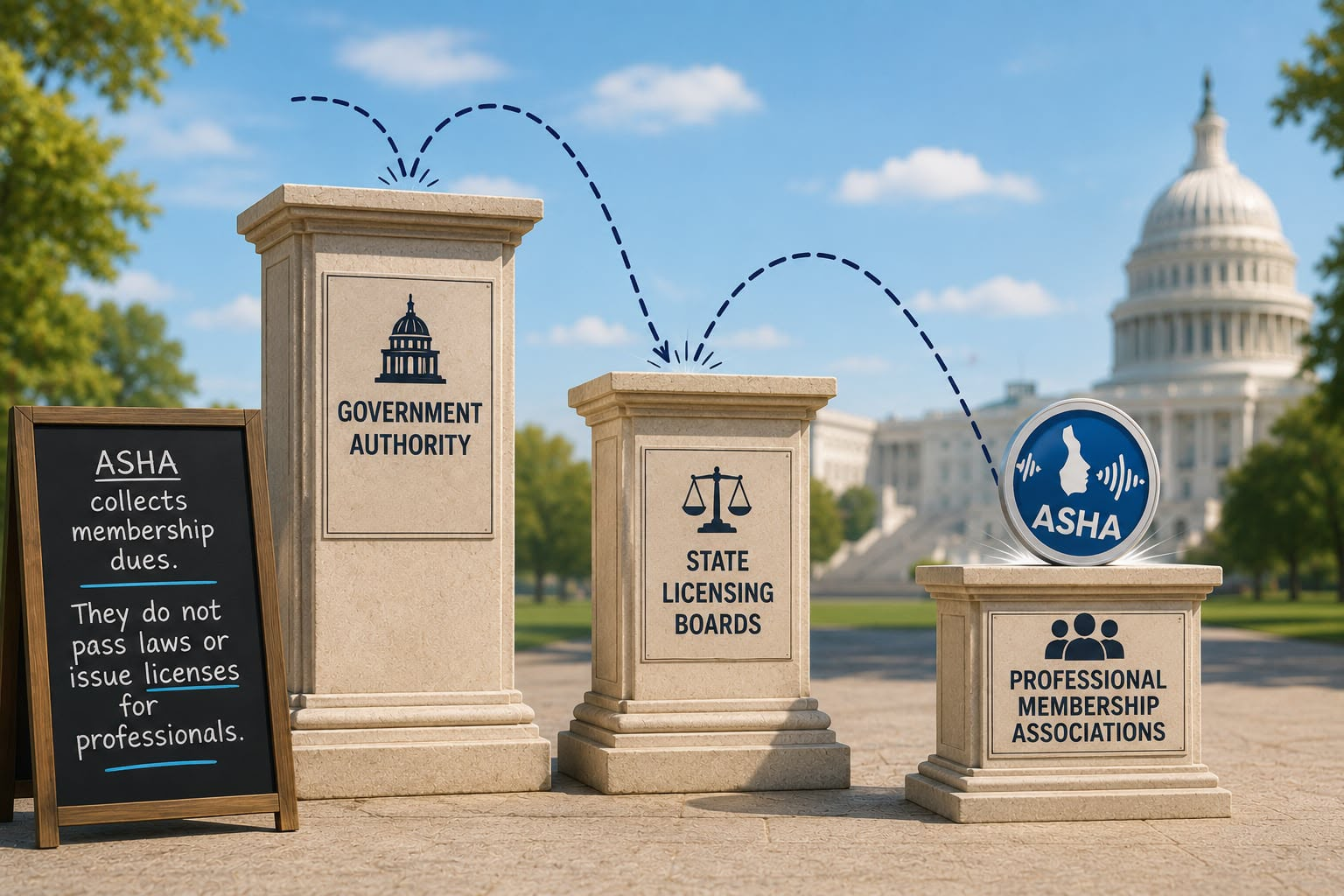
The underlying reality is simpler and more uncomfortable. ASHA is a private membership association. Its positions are opinions, not law.
1. ASHA is a membership association, not a government agency.
ASHA is a professional organization with members, leaders, committees, staff, conferences, and publications. It operates with budgets, priorities, and institutional traditions. It does not pass laws. It does not issue state licenses. It is not elected by the public, and families have no direct way to vote its leaders out of office.
Despite this, school administrators and state officials routinely describe ASHA as "the governing body" for speech-language pathology, and SLPs report being told that they cannot support particular communication methods because "ASHA does not allow it." That language creates an illusion of legal authority where none exists.
ASHA can provide guidance and interpret research. It cannot determine an individual child's legal entitlement to communication supports in an IEP, nor can it override state licensure laws or federal disability statutes. When a district or agency denies a method solely because "ASHA does not support it," it is adopting a private association's preference, not complying with a mandate.
2. An association is not science. It is people interpreting science at a particular moment.
Professional associations are made up of human beings. Evidence changes. Ethical standards evolve. Individuals with lived experience gain access to conversations where they were previously excluded. As these shifts occur, responsible organizations revise earlier positions.
The American Medical Association and American Psychological Association have both reversed previous stances as research and ethics developed. Those reversals demonstrate that institutions can be wrong, incomplete, overly cautious, influenced by prevailing beliefs, or slow to reconsider deeply embedded views.
ASHA should be understood in the same way. Its position statements represent the conclusions of specific committees, applying particular standards to selected bodies of evidence within a given period. They are not permanent scientific truths. Treating current positions as if they were fixed law undermines scientific inquiry, which depends on continued questioning and openness to new data, including the observed communication of nonspeaking individuals and their families.
3. The CCC is described as voluntary, but many SLPs experience it as necessary for employment.
A state license is what provides a speech-language pathologist's legal authority to practice. The CCC is a private credential issued by ASHA. In principle, these are distinct.
In practice, many school districts and other employers require or strongly prefer the CCC. Some tie additional compensation or advancement to maintaining it. SLPs may reasonably fear that allowing the credential to lapse will limit their employment, supervision opportunities, mobility, salary, or future career options.
This helps explain why so many SLPs continue paying for the CCC even when they disagree with ASHA's positions or do not feel they receive sufficient value from membership. Continuing to hold the credential is not necessarily an endorsement of every ASHA statement. Often, it is an effort to protect one's livelihood in a system that has made the credential difficult to leave.
4. ASHA has institutional incentives to preserve the value of the CCC.
ASHA is a large organization with employees, programs, technology, publications, conferences, accreditation activities, and long-term financial obligations. These operations require recurring revenue. Membership dues and certification-related payments are central to that revenue.
A significant decline in the number of SLPs maintaining the CCC would likely have substantial financial implications for ASHA, just as losing a large percentage of members would affect any national association. Organizations are structured to survive. They have incentives to preserve the perceived value of their credentials, sustain membership, defend long-standing programs, and demonstrate that the services they sell remain necessary.
When an association issues a credential, benefits financially from its maintenance, influences the training pipeline, and holds sway over employment practices in public systems, the public has every right to ask what safeguards exist to prevent institutional interests from being confused with objective professional truth.
5. SLPs who exercise independent judgment should be supported, not isolated.
Many SLPs do not accept that ASHA's position on motor-based or assisted communication should end the inquiry. They listen to nonspeaking people directly. They study neuromotor and sensory differences. They observe spelled communication over time and across contexts. They consider authorship, prompting, partner influence, regulation, safety, and the individual's presentation. They document their clinical reasoning and continue supporting communication because they believe categorical rejection would cause greater harm.
These clinicians should not be portrayed as irresponsible simply because their conclusions differ from those of a private association. Thoughtful disagreement is a normal and necessary feature of a developing profession. Licensed SLPs need peer networks, access to balanced research, legal clarity, and employers willing to affirm that individualized clinical judgment is permitted even when it departs from an association's position statement.
The most troubling aspect of the current system is not that some SLPs disagree with ASHA. It is that exercising independent professional judgment can feel like an act of rebellion. In a healthy evidence-based culture, it should feel like the job.
What families can do
If you are a parent or family member, you can share this article directly with your child's school, district leadership, or the state officials who oversee certified programs and residences. You may wish to include a simple request:
"Please identify the specific statute, regulation, or licensure rule that prohibits my loved one's spelled communication, and explain how that legal authority differs from a position statement issued by a private membership association."
Learn more
- The SLP Taking On ASHA's Monopoly — The Lighter Side of the Spectrum
David Kaufer interviews Dr. Jeanette Benigas, founder of Fix SLP.
- comm4commrights.org — David Kaufer
Ongoing documentation of ASHA's influence on communication access.